Restoring Quiet, Balanced Steam Comfort in Queens Homes
Steam heating is an elegant, durable method of home heating engineered for maximum comfort, but it operates on delicate thermodynamic principles. In historic neighborhoods like Douglas Manor and established sections of Douglaston and Little Neck, cast-iron radiators provide steady radiant warmth. However, when steam valves corrode, air vents seize, or pipes sag over decades of building settling, the heating system reacts with deafening water hammer, dripping floors, or frustratingly cold rooms.
Steam systems must breathe freely. In a standard one-pipe system, rising vapor must push through the same pipe where cooled condensate returns by gravity back to the cellar boiler. If an air vent fails to open or a supply valve is partially stuck, the entire thermal balance collapses. Our technicians specialize in diagnosing steam distribution challenges, correcting pitch, replacing leaking shut-off valves, and installing precision-metered vents.
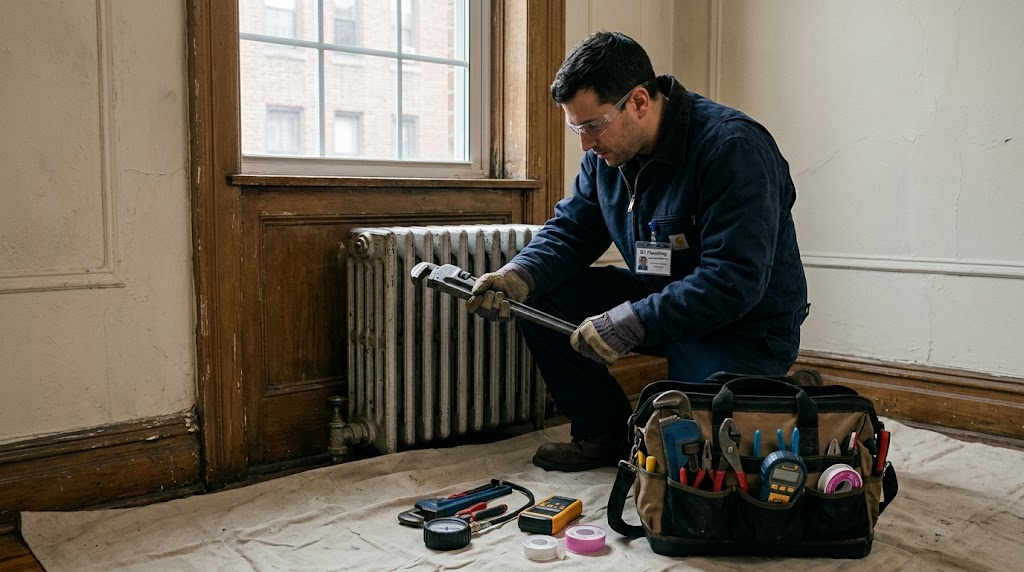
Common Radiator Malfunctions We Diagnose & Repair
Precision solutions for noisy, uneven, or leaking cast-iron and convector radiators.
Water Hammer & Pipe Clanging
Rising high-velocity steam slamming into trapped pools of condensate water creates loud metallic banging. We correct pipe pitch and shim radiators to restore gravity drainage.
Completely Cold Radiator Units
Air-bound radiators cannot heat because blocked, calcified air vents trap cold air inside. We install calibrated thermostatic air vents matched to room heat demands.
Leaking Valve Stems & Puddles
Deteriorated valve stem packing or corroded spud unions drip rusty water onto hardwood floors. We repack glands or replace frozen heavy-brass supply valves.
Step-by-Step Steam Balancing & Valve Restoration
How our technicians restore quiet, even heat distribution across every level of your home.
System-Wide Steam Pressure & Pitch Audit
We test boiler operating pressure (verifying the pressuretrol is set below 2.0 PSI) and check the pitch of all basement steam mains and individual radiator runouts.
Main Line Quick-Vent Testing
Basement steam mains must expel air rapidly before steam reaches radiators. We inspect and replace slow or seized main line air vents to ensure swift steam propagation.
Valve Packing & Spud Replacement
We rebuild leaking valve stems with high-temperature graphite packing or extract stubborn, corroded brass spuds to install new heavy-duty steam supply valves.
Room-by-Room Radiator Vent Balancing
Installing variable or proportional air vents tailored to radiator size and distance from the boiler, eliminating cold spots while preventing bedroom overheating.
Connected Heating Infrastructure
Persistent radiator issues can sometimes be symptoms of basement equipment problems, such as high boiler water levels or pressuretrol failures. Read more about our root-cause Boiler Repair services, or consider seasonal Boiler Maintenance to keep your steam boiler performing at peak efficiency.
Radiator Repair Frequently Asked Questions
Expert guidance on steam heat balancing, knocking pipes, and radiator maintenance.
Violent banging or hammering—technically known as water hammer—happens when fast-moving steam hits trapped pockets of cooled condensate water inside the pipe or radiator. This commonly occurs if the radiator has lost its downward pitch toward the supply valve, if the shut-off valve is partially throttled, or if the air vent is malfunctioning.
In a steam heating system, steam cannot physically enter a radiator until cold air is vented out. If the radiator's air vent is corroded, painted over, or scaled shut, trapped air forms a barrier that blocks steam from ever entering the radiator.
No. On a standard one-pipe steam system, the radiator supply valve must always be either 100% open or 100% closed. Leaving it partially open restricts the passage where steam enters and condensed water returns, causing severe water hammer and leaking valve stems.
Continuous hissing or spitting water indicates that the internal thermal float or bimetallic disc inside the air vent has failed due to mineral sediment or age, preventing it from sealing when hot steam reaches the chamber.