Protecting Queens Cellars Against Hydrostatic Groundwater Pressure
The unique geographic location of Douglaston and Little Neck—bounded by Little Neck Bay, Alley Creek wetlands, and hilly suburban terrain—creates pronounced water-management demands. During fierce coastal nor’easters, tropical storm remnants, and rapid snowmelts, groundwater tables surge dramatically. Sub-grade basements and cellars built into sloping grades face severe hydrostatic pressure pushing water through foundation cold joints and floor slab cracks.
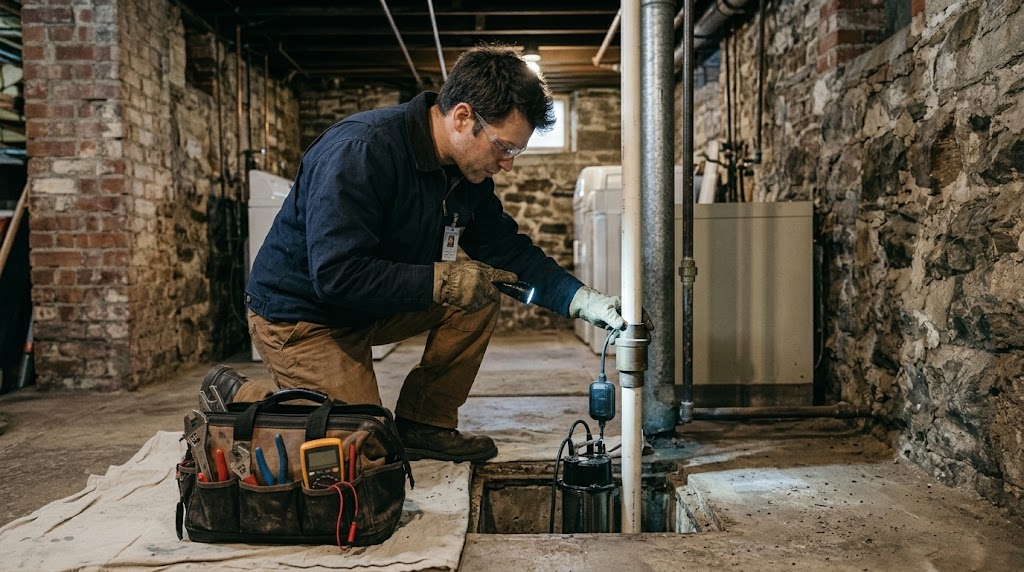
A dependable sump pump system is a home’s primary line of defense against costly basement water intrusion. However, a primary pump powered exclusively by utility power is vulnerable to grid outages precisely when storms are at their peak. We engineer dual-pump configurations featuring cast-iron primary units paired with commercial-grade auxiliary battery backups and backwater check valves to keep living spaces dry.
Understanding Groundwater vs. Municipal Sewer Backups
Many homeowners confuse groundwater infiltration with sewer backups, but they originate from distinct sources and require different engineering protections:
- Submersible Sump Pumps: Manage subterranean groundwater. Perforated drain tile around foundation footings channels rising groundwater into a basin, where the pump discharges it away from the home’s exterior walls.
- Sewer Backwater Valves: Manage overloaded municipal sewers. When heavy rain saturates street storm mains, city sewage can surge backward into residential house drains. A backwater valve contains a buoyant flapper that automatically closes under reverse pressure, protecting basement floor drains and fixtures.
Our Flood Defense Diagnostic & Installation Workflow
Engineering multi-tiered water protection systems tailored to your property’s elevation and risk.
Basin & Infiltration Assessment
We inspect basin depth, clear gravel debris, inspect incoming perimeter drain tile flow rates, and verify that the basin has an airtight sealed cover.
Pump Motor & Float Switch Testing
Testing mechanical vertical float switches, measuring motor amp draw, and testing cast-iron vortex impellers to guarantee rapid gallon-per-hour output under head pressure.
Discharge Line & Check Valve Calibration
Installing spring-loaded silent check valves to prevent water hammer and drilling weep holes in discharge piping to eliminate air-lock risks.
Commercial Battery Backup Commissioning
Mounting secondary 12-volt backup pumps, testing smart AGM charging controllers, and simulating primary power outages to ensure seamless automatic switchover.
Complete Cellar Protection Strategy
Basement water management also relies on intact underground waste lines and pressurized supply plumbing. Check our Sewer Line Repair service to ensure your main drain runout is clear of tree roots, or consult our Pipe Leak Detection & Repair specialists if you notice mysterious moisture near foundation walls.
Sump Pump Frequently Asked Questions
Practical answers on pump maintenance, backup power, and basement flood mitigation.
The most common causes of storm-related sump pump failures are grid electrical power outages, a mechanical vertical float switch jammed against basin walls, gravel sediment clogging the cast-iron impeller, or a failed inline check valve allowing pumped water to flow back into the pit.
Yes. Low-elevation coastal topography, high tidal groundwater tables near Little Neck Bay and Alley Creek, and severe storm surges subject nearby foundations to elevated hydrostatic pressure compared to elevated ridge properties.
A battery backup system includes a secondary 12-volt submersible pump mounted above the primary pump in the pit, wired to a commercial marine AGM deep-cycle battery and intelligent charger. When primary power drops or the main pump fails, the auxiliary pump engages instantly.
A sump pump extracts groundwater from beneath the concrete floor slab and pumps it away from the foundation. A sewer backwater valve is a mechanical flapper check valve installed on the main building drain that prevents overloaded city street sewer wastewater from backing up into basement fixtures.